
Sources For San Leandro Previous Residents
One address has several time layers. The Recorder establishes recorded parties and instruments. The Assessor and GIS preserve the current parcel bridge. City directories name listed occupants, Haines reverses the address, census schedules show an enumerated household, and Sanborn maps show a structure or use. Probate, newspapers, and obituaries can explain what happened after an owner died or a family moved.
The table keeps the source roles distinct. Coverage is not the same as completeness. A directory can omit a household, a newspaper run can be broken, and an older web index can stop before the house was built.
| Source | Years It Covers | Where Held | What It Shows |
|---|---|---|---|
| Alameda Recorder | 1853-present; electronic party index 1969-present | Oakland office and official service | Recorded parties, instruments, legal descriptions, chain events |
| Assessor and GIS | Current; historical start unstated | Alameda public map | APN, situs/mailing, values, exemptions, latest document clue |
| San Leandro city directories | 1925-1965 | History Room | Names, addresses, and publisher-coded household or work clues |
| Haines criss-cross | 1973-1982, 1984-2019 | Oakland Public Library | Address-first listed occupant or phone; 1983 gap |
| Federal census | Through 1950 in 2026 | NARA and research access points | Enumerated occupants, relationships, ages, and address |
| Sanborn maps | 1885, 1890, 1898, 1907, 1911, 1917 | History Room and Library of Congress | Footprint, use, number, and street context |
| Newspapers and probate | Multiple local runs; probate files by case | History Room and Alameda Court | Death, notices, heirs, successor clues, and events |
Begin with the current parcel even when the goal is a nineteenth-century household. The APN and legal description make the backward trail testable.
San Leandro Previous Residents APN
Search the Alameda property portal by situs address or parcel number. Save the APN, book/page/parcel/subparcel pieces, situs and mailing addresses, land and improvement values, homeowners exemption, use code, and latest document prefix, series, and date. The public layer does not show an owner-name field, so repeating the same name search will not reveal a hidden owner.
The latest instrument clue points to the Alameda Clerk-Recorder. Retrieve the purchase deed or copy using the instrument number, book/page, or reel/image. Record grantor, grantee, recording date, legal description, title form, and prior-instrument reference. A grantor transfers an interest; a grantee receives it. The chain becomes a sequence of named transfers tied to one parcel.
A mailing address may point away from the parcel. A homeowners exemption may support a cautious principal-residence inference, but neither field proves every past household. The property map is the bridge, not the conclusion.
The linked Alameda official-records route is the deed custodian for the previous residents trail.
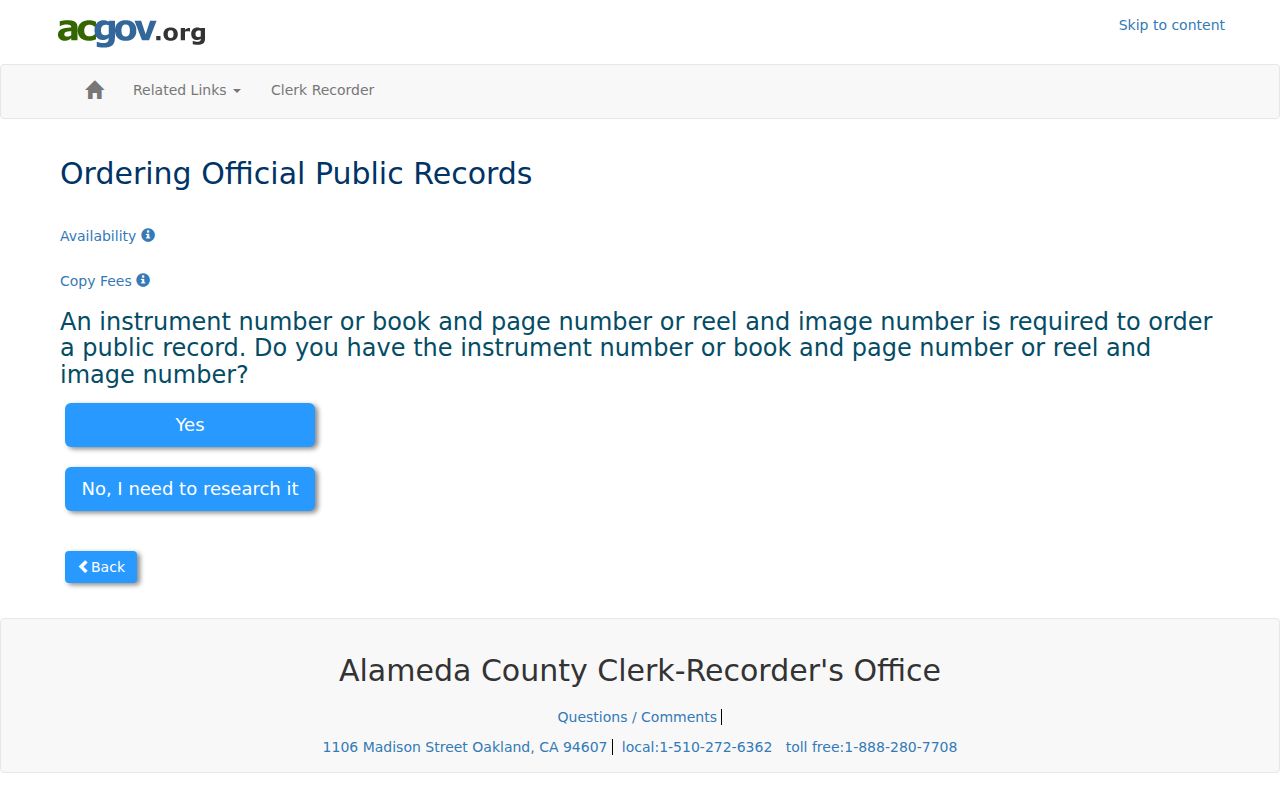
The Recorder capture marks the handoff from a parcel clue to a named instrument.
San Leandro Previous Residents Deed Chain
After the latest deed is identified, take the seller's name back into the Recorder index as an earlier buyer. Repeat the grantor-to-grantee loop for each transfer. Match the APN, legal description, lot, block, book, page, and date. A surname alone is not enough when a common name appears in several Alameda parcels.
- Search the current situs in GIS and save APN, latest document prefix, series, and date.
- Order or inspect that instrument and write down grantor, grantee, legal description, and prior-record reference.
- Search the grantor as an earlier grantee in the next older date band.
- Reject a branch when the parcel or legal description does not match, even if the name does.
- Continue until the chain reaches the property archive boundary or a reliable historical source.
Alameda's electronic party-name index runs from 1969 to the present. The recorded-property archive begins in 1853, so the digital stop is not the historical stop. A copied deed's prior-instrument reference may shorten the next search.
- Chain of title
- The ordered set of recorded transfers or interests that connect a parcel across time.
- Legal description
- The recorded land language that identifies the parcel beyond a changing street label.
- Grantor and grantee
- The transferring and receiving parties named in an instrument.
San Leandro Previous Residents Legal Descriptions
A legal description is the safety rail for a previous residents search. Streets are renamed, numbers change, and a later subdivision can divide one older tract. Ward Street is identified in a History Room caption as “now Estudillo.” Herma Court does not appear until 1925. A surname that looks right but sits on another parcel is the wrong trail.
Compare the instrument's legal description with APN components, book and page, plat references, and the next deed. If a map or directory uses a former street name, search both forms. If the parcel changes shape, use Sanborn, tract, and recorded descriptions to explain the shift before assigning an earlier household.
This is a place where a small field is more useful than a polished narrative. Keep the exact number, street label, date, and parcel reference beside each previous resident name.
San Leandro Previous Residents Before 1969
For instruments from 1969 forward, the online party index is the efficient route. For 1853 through 1968, research the alphabetical microfilm index in person at 1106 Madison Street in Oakland. Bring spelling variants, approximate date, party role, APN or legal-description clue, and any prior instrument reference. The office says index research is free, while copies carry page and certification charges.
Counter hours are Monday through Friday from 8:30 a.m. to 5 p.m. Printing stops at 4:15 p.m.; recording stops at 4:30 p.m.; noon to 2 p.m. is the busiest period. Mail requests need an identifier and a self-addressed stamped envelope and are stated as five to ten business days. Plain copies are $3.50 per page, certified copies are $4.50 for the first plus $3.50 for each additional page, and online orders add $2.
The Oakland location is expected. Oakland is the Alameda County seat, while San Leandro is a separate incorporated city. A county counter address does not change the locality of the property.
San Leandro Previous Residents Directories
The San Leandro History Room holds Hayward and San Leandro city directories from 1925 through 1965. Polk combined Hayward and San Leandro volumes include 1948 and 1951, and Polk San Leandro issues include 1955-56, 1959, and 1965. An entry may give a name, address, occupation, spouse marker, or abbreviation, depending on the publisher. Exact local shorthand must be inspected in the physical volume because no open digitized sample was verified.
Use a directory after the deed chain has supplied a date window, or use it to explain who was listed between transfers. A listed person may be an occupant, owner, family member, or business contact. It is a historical clue, not a certified statement of every household at the address.
The full collection descriptions and reading method appear in the San Leandro city directory collections. The previous residents trail borrows the dated address clue and keeps the backward parcel question in view.
San Leandro Previous Residents Haines
Haines East Bay and Southern Alameda criss-cross directories provide the address-first bridge after the local 1925-65 run. Holdings cover 1973 through 1982 and 1984 through 2019, with 1983 absent. Read the street and number sequence, copy the listed occupant or phone clue, and compare the next available year. A gap in 1983 is a collection limit, not a settled move.
Haines can narrow when a household appears or disappears. Pair it with a deed for title, a census for a whole enumerated household, a newspaper for life events, or a permit for construction. Do not treat a directory omission as proof that an address was vacant.
The Oakland Public Library holdings page documents the shelf. Oakland's regional repository is useful for San Leandro previous residents because the collection scope is East Bay and Southern Alameda.

The Haines and Polk shelf provides an address-first historical layer that modern parcel fields do not contain.
San Leandro Previous Residents Sanborn Maps
The local Sanborn sequence includes March 1885, August 1890, April 1898, January 1907, March 1911, and April 1917. The maps can show a building footprint, use, street number, and nearby structure. They cannot name every person, but they can establish whether an address or building existed when a directory or deed mentions it.
Start with a directory address and year. Open the closest Sanborn sheet, inspect the footprint and number, then pair it with the next public census. Move year by year through directories, maps, newspapers, and instruments. If the street is absent, test a renamed road, new court, subdivision, or later annexation rather than assuming the source is wrong.
The Library of Congress Sanborn sequence supplies free map items for the documented editions. A map and a directory answer different questions and become stronger when read together.
San Leandro Previous Residents Census Years
Directories narrow a move; census schedules test the whole household. The 1950 census is the latest public federal census in 2026. It can show occupants, relationships, ages, and address at enumeration. A city directory can place a listed name before or after that date, add a street number, or show an address change that a ten-year interval hides.
- Choose the closest directory year and preserve its title, page, street, number, and spelling.
- Find the nearest census and compare names, relationships, ages, and address.
- Use the next directory year to test continuity or a move.
- Check a newspaper, obituary, deed, probate file, or Sanborn map for the reason behind the change.
Family history benefits from the difference between a yearly listing and a ten-year enumeration. A directory may omit a child or list one adult; the census may identify a household structure. Neither is a complete modern resident directory.
San Leandro Previous Residents Probate
When an earlier owner died, probate can connect a name to heirs, notices, and a later deed. Search Alameda eCourt or request a case by name, case number, document title, and filing date. Inspect the petition, Register of Actions, public heirs, and available images. Then return to the Recorder and look for the inherited or successor instrument on the same APN or legal description.
The History Room's newspaper runs can supply an obituary or announcement. Staff accept obituary requests by email at historyrequest@sanleandro.org or by mail and ask for a full or maiden name, exact date when possible, month and year at minimum, plus place, age, or date-of-birth clues. Broken newspaper runs mean absence is not proof that a death went unreported.
Alameda County's real-estate fraud letter program supplies a current parallel. A new recorded document can trigger a notice with the first page and Real Estate Fraud Unit contact information. The program helped an elderly owner detect a fraudulent transfer in fiscal year 2024-25. A current owner alert can therefore protect the accuracy of the future deed chain.
Detect A Renamed San Leandro Street
Address history can fail at a street label. Search Ward and Estudillo together. Search Herma Court only from its documented 1925 appearance forward. Compare the legal description, APN, Sanborn sheet, directory street section, and tract instrument. A former label may appear in a deed while a later directory uses the current name.
Keep two timelines: one for the land and one for the people. The land timeline records subdivision, structure, street name, and instrument. The people timeline records listed occupant, owner, obituary, census household, and probate connection. They meet at the APN and legal description.
This method protects the previous residents search from turning a missing web hit into a false conclusion. An address can be new, renamed, renumbered, or outside the date range of a collection.
San Leandro Past Residents
Past households are found by layering evidence, not by assuming that a deed lists everyone. Use the Recorder for title parties, city directories and Haines for listed people, the census for enumerated relationships, newspapers for life events, and probate for heirs. The History Room is the local access point for directories, maps, clippings, newspapers, and images.
Previous residents research supports family history, a house timeline, an heir question, or a historical neighborhood study. It should preserve uncertainty where the sources disagree. A same-name match needs a date, address, role, or legal-description link before it is carried forward.
For the current street and parcel chain, the San Leandro street directory supplies the address-first workflow. The historical collection itself remains on the city directory page.