
San Leandro Resident Lookup Coverage
One-person research works when the record choice matches the question. A parcel record can show situs, mailing, and a title trail, but owner is not occupant. A court record can show parties, dates, and roles, but a sealed case may not appear. A vital record confirms an event under eligibility rules. A business or license result establishes a public affiliation. A custody or registry result shows a statutory status, not a complete life history.
The table is an evidence grid. It keeps a San Leandro resident lookup from treating every name hit as the same kind of fact.
| Record | What It Can Confirm | Where | Access |
|---|---|---|---|
| Parcel and tax | Situs, mailing, APN, values, exemptions, latest instrument clue | Alameda Assessor and GIS | Free public map; some fields suppressed |
| Recorder instrument | Named parties, transfer event, legal description | Alameda Clerk-Recorder | Party index and paid copies |
| Court case | Case number, filing date, roles, docket, public images | Alameda Superior Court | Channel and case type dependent |
| Vital record | Birth, death, marriage, or divorce event | Alameda Clerk-Recorder or CDPH | Authorized or informational rules |
| Voter status | Personal registration, districts, polling, ballot status | California Secretary of State | Self-lookup or qualified file |
| Business or license | Entity, license status, public affiliation address | SOS, DCA, county, city | Free search; scope varies |
| Custody or registry | Current or statutory custody and registry information | County, state, or Megan's Law tools | Public fields with warnings |
Start with the least ambiguous route. If the name is common, an address or date matters more than a broader search.
San Leandro Resident eCourt Fields
The Alameda eCourt portal covers civil and related public case types, including family, probate, mental-health, and adoption channels subject to access rules. Registration is required, and paid searches or downloads need a card. Name Search is paid, returns up to 1,500 cases, and provides up to ten cases for a found name. Case Number Search reveals a narrower record set and is the better route when a case number is known.
| Name Search | Name required; case numbers and filing dates, with a large-result cap and paid credits. |
|---|---|
| Case Number Search | Parties, Register of Actions, minutes, future hearings, and available images. |
| Calendar Search | Date and location; department calendar results. |
| Public Reports | Date, location, and type browse for nonconfidential cases filed that day. |
| Document Downloads | Case number; nonsealed and nonconfidential images, with page charges and a document cap. |
| Case Payment | Case number; outstanding fee information. |
Name credits range from $1 for one search to $4 for five, $7 for ten, $45 for 75, or $300 for 30 days unlimited. Downloads cost $1 per page for pages 1-5 and $0.50 after that, with a $50 document cap and 30-day availability. Public terminals can display public information without remote web charges.
The Alameda court records page is the official starting point for the resident lookup.
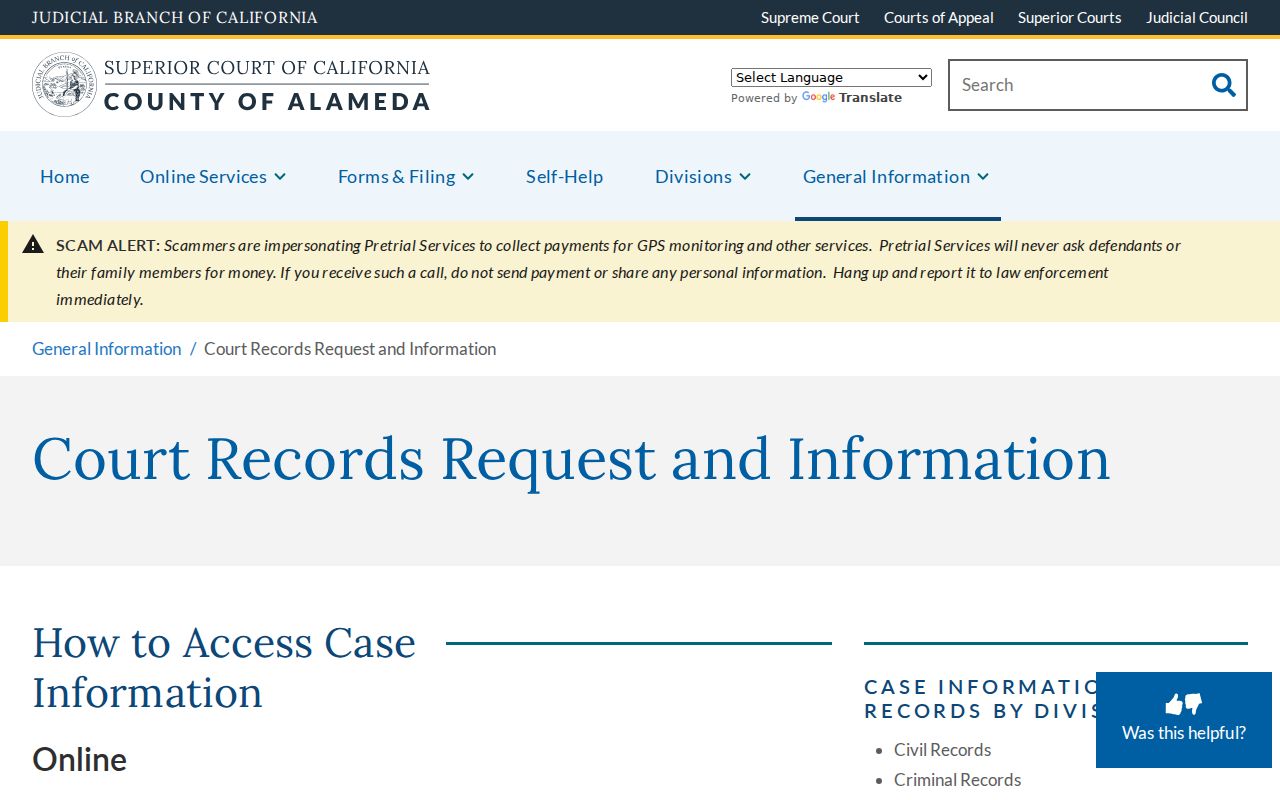
The court capture shows why a name search needs a case type, date, and role before it becomes useful evidence.
San Leandro Resident Court Channels
A negative eCourt result does not clear the full Alameda court system. Odyssey supplies criminal public information and lists activity since 2005, but it does not provide web document images. Traffic uses a separate portal. Its fields include citation or docket number, court, last name or organization, date of birth, driver's license number, and begins-with or similar-sounding choices. Records older than three years are absent electronically, and the payment vendor adds a $6 fee.
In-person public access reaches many criminal cases opened since 1974. The court will not research by phone or email, so a case number, party name, filing date, document title, and delivery choice should be ready for a records request. A civil request can ask for plain, certified, or exemplified copies. The published charges include $0.50 per page, $15 for a no-number search, $15 for a divorce certification plus pages, $40 for other certification, $50 for exemplification, and $10 for offsite retrieval.
Federal cases require the Northern District of California or PACER. Juvenile, adoption, sealed, confidential family, mental-health, and victim records may be excluded or redacted. A court result is a case record, not a conclusion about a person's character or current life.
Verify One San Leandro Resident Lookup
A reliable resident lookup anchors the name before it expands. Start with an exact name plus a known address or date. Compare the parcel's situs and mailing fields. If a court result appears, check the party role, middle initial, filing date, and Register of Actions. Use a business or license file only to corroborate a public affiliation. For a deceased person, connect a death clue to probate, an obituary, or a successor deed.
Use this sequence for one verification task:
- Write down the name, spelling variants, approximate age or date, address, and reason the record is relevant.
- Check Alameda GIS for the address and preserve the APN, situs, mailing, and latest instrument details.
- Run the matching court channel, then compare the party role, case date, and public docket fields.
- Choose a vital, business, license, probate, or historical source that answers the remaining question.
- Correct the source record with its custodian before asking downstream compilers to change a copy.
- Docket
- The court's running record of filings, actions, and events in a case.
- Index versus image
- An index helps find a record; an image or certified copy supplies the underlying document when access permits.
- Certified copy
- A copy issued with the custodian's certification, sometimes limited to an eligible requester or purpose.
When the goal changes to every parcel on a road, use the San Leandro street directory instead of widening one-person research without a clear question.
San Leandro Resident Vital Copies
California does not use a simple rule that every modern birth record opens after a fixed number of years. Health and Safety Code sections 103525 and 103526 distinguish authorized certified copies from informational certified copies. Alameda County's ordering route lists birth, death, public marriage, and confidential marriage choices. Authorized categories include the registrant or parent, a spouse or domestic partner, certain close relatives, an attorney for a registrant or estate, a court-authorized person, and defined agency or funeral roles. Remote unrestricted requests require a sworn statement and notarized acknowledgment.
| Alameda birth | Unrestricted or informational choices; local schedule lists $36. |
|---|---|
| Alameda death | Unrestricted or informational choices; local schedule lists $28. |
| Public marriage | Unrestricted or informational public choice; local schedule lists $21. |
| Confidential marriage | Party or court order under Family Code section 509; local schedule lists $21. |
| State CDPH | 2026 fees list birth $31, death $26, marriage $19, and dissolution certificate $18. |
An informational copy can help genealogy but is marked not valid to establish identity. The CDPH fee schedule gives the current state amounts, while its application index routes birth, death, and marriage requests. CDPH does not email or fax certificates, and a no-record result keeps the search fee. Divorce decrees come from Superior Court; CDPH's limited divorce certificates cover 1962 through June 1984 and provide basic facts.
San Leandro Resident Voter Status
California My Voter Status is a self-service registration check. It can show a person's registration, polling place, districts, materials, and whether a vote-by-mail or provisional ballot was counted. It is not a public San Leandro resident lookup by name. The voter file contains restricted fields and is released only to qualified applicants for permitted election, political, scholarly, journalistic, governmental, or record-review purposes.
The published application asks for applicant identity and contact details, a government photo ID, statewide or county scope or up to ten voters, intended use, a wet signature, and payment. Specific-voter requests are $30 each, up to ten records and $100; a statewide file is $15 per 1,000 records with a $100 maximum. Elections Code sections 2188, 2188.2, 2194, and 18109 govern the access and misuse limits. A protected address stays protected.
Do not try to turn a self-check form into an anonymous name search. Choose a different public record if the question does not fit a lawful voter-file purpose.
San Leandro Resident License Files
A professional license can verify a person, board, license type, number, status, issue or expiration information, and discipline links. The California DCA search supports board, license type, license number, business name, first name, last name, city, county, and ZIP filters, although several boards use separate systems. State Bar, DRE, Contractors State License Board, teacher credential, and Department of Insurance searches may be needed for a particular profession.
bizfile Online searches entity name or number and may show formation dates, jurisdiction, status, principal and mailing addresses, agents, officers or managers, Statements of Information, and filing history. Alameda fictitious-business-name filings connect local trade names to an entity or person. A service-company agent address is not a home address, and a business affiliation is not residency.
Pair the sources only when they answer the same identity question. The resident lookup should say whether a result confirms a person, a business role, or an address clue.
San Leandro Resident Probate Heirs
Probate can connect a deceased person to heirs and a recorded parcel. Start with the name in Alameda eCourt or a court records request. Review the petition, Register of Actions, public heirs or notices, and any available image. Then search the Recorder for an inherited or successor instrument tied to the same APN or legal description. A probate clue is stronger when the court role, death date, parcel, and later deed align.
For a forgotten-property lead, the State Controller's unclaimed-property search can show reported owner name, reported address or city, property type, holder, and property ID. It is not proof of present residence. A claim requires a separate identity and entitlement process. For a birth parent, California uses a confidential adoption procedure rather than a public name index.
This human-use route keeps the San Leandro resident lookup focused on estate and family history. It does not expose a private household through a broad name hunt.
San Leandro Lookup Privacy Dead Ends
Some result gaps are deliberate. Juvenile records are controlled by Welfare and Institutions Code section 827. Adoption records follow Family Code section 9200 and related rules. Confidential marriages are available to a party or by court order under Family Code section 509. Safe at Home participants receive a substitute mailing address and forwarding protection under Government Code sections 6205 through 6216. Sealed, confidential family, mental-health, victim, and protected-address data may not appear in an ordinary search.
California's DROP service can reduce covered commercial data-broker copies, but it does not remove an official record that a custodian must keep. A missing address can therefore be a safety control, not a data error. Do not try to defeat that control by combining unrelated records.
The Alameda County Sheriff inmate locator, CDCR incarcerated-person locator, and California Megan's Law search are narrow statutory tools. They report current or publishable status fields and carry reuse warnings. They do not establish conviction, full history, or present residence.
The official Alameda inmate locator is the correct narrow route for current county custody information.
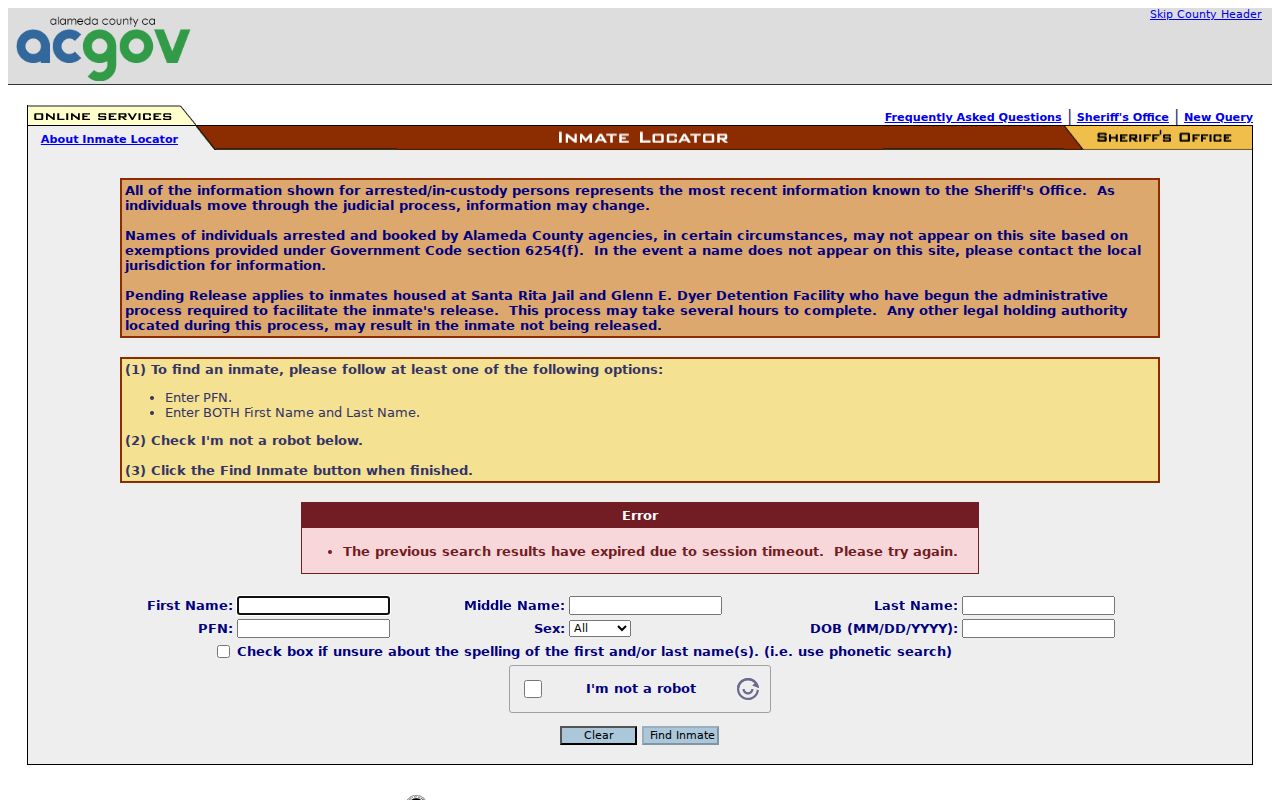
The custody image belongs to a defined status search, not to a general resident list.
Legal Limits On A San Leandro Lookup
California's records laws support personal research, genealogy, civic transparency, reconnecting, and estate work. They do not make every field open to every person. Voter information has purpose limits, DMV information is restricted, and public registry data has statutory reuse rules. Civil Code section 1708.7 and Penal Code section 646.9 address stalking and harassment, while the voter misuse rule appears in Elections Code section 18109.
If a result is wrong, correct the originating custodian first. The Assessor or Recorder handles a property or deed issue, the court clerk handles a docket, the Registrar handles voter status, and the Secretary of State or county handles a business filing. Send corrected source evidence to a downstream compiler only after the official record is addressed.
When the evidence is historical, the San Leandro city directory collections add a dated local clue without pretending that an old listing is a current address.
San Leandro Lookup Updates
California's 2026 changes make source dates worth saving. Vital-copy fees rose at the state level. DROP opened as a one-stop broker deletion route. Alameda's fraud-letter program continues to alert owners when a new real-estate document is recorded. None changes the core verification rule: identify the source, read the access limit, and compare a second record only when its field answers the same question.
The Megan's Law capture demonstrates that a public registry has its own statutory search surface and warnings.
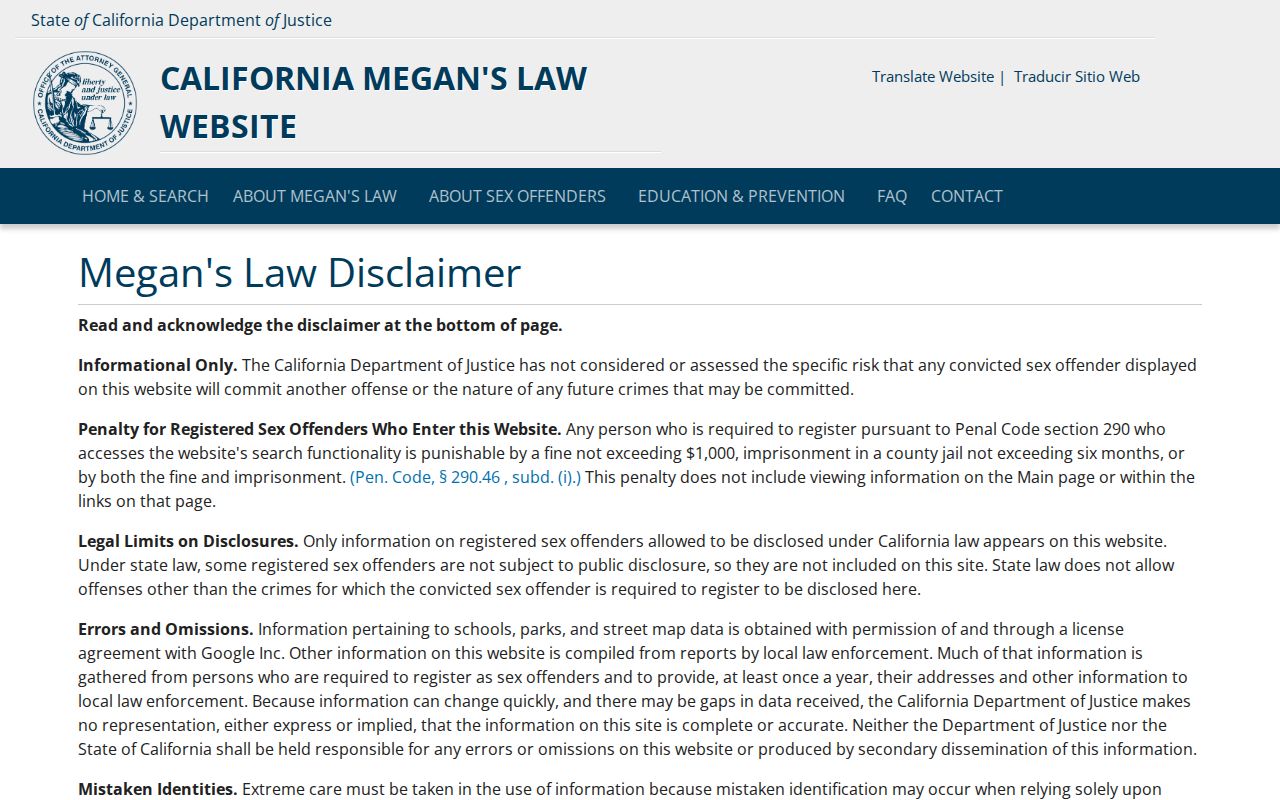
A narrow public result is still not a complete resident profile. The Megan's Law statute defines the disclosure and reuse boundary. Preserve the date, record type, and official URL with any note.